logo-oibr
  • OIB
    • About
    • News
    • Director's Yearly Address
      • Director's Address 2020
      • Director's Address 2019
      • Director's Address 2018
      • Director's Address 2017
    • Advisory board
    • Reports
    • Newsletter
    • In the Media
    • Gallery
  • Events
  • Research
    • Current projects
      • From Arabic to Latin: Moving sciences of music around the Mediterranean (Rosy Azar Beyhom)
      • Abrahamic Interdependence - Relationship of the Islamic to the Jewish in Marital Law (Ahmed M. F. Abd-Elsalam)
      • Lebanon’s Art World at Home and Abroad: Trajectories of artists and artworks in/from Lebanon since 1943 (LAWHA) (Nadia von Maltzahn)
      • Cultural Policies in Lebanon: Cultural Institutions between State and Society (Nadia von Maltzahn)
      • The New Testament quotations in Ibrahim al-Biqāʿīs (st. 1480) commentary on the Koran (Thomas Würtz)
      • Balance as Justice: Deconstruction of premodern ethics on the basis of Qinālīzāde ꜤḲınālīzāde ʿAlī Çelebī’s Akhlāq-i ꜤAlā’ī (Fatih Ermiş)
      • Fictio Statis (Pierre France)
      • Discourses on Statehood in Iraq (Christian Thuselt)
      • From Copying to Burning the Qur’an: Creating Models & Transposing Sacrality (Alya Karame)
      • Living in Liminality (Sarah El Bulbeisi)
      • Escape to Europe: Comparative Refugee Imaginaries (Markus Schmitz)
    • Previous projects
      • The Lebanese Intifada of October 17: Perspectives from Within (Birgit Schäbler)
      • Relations in the Ideoscape: Middle Eastern Students in the Eastern Bloc (1950's to 1991) (Birgit Schäbler)
      • Europe and the Middle East (Birgit Schäbler)
      • Picturing the (Un)Dead: Reflections and Deconstructions of Lebanese and Iranian "Martyrs" in Contemporary Photo-Related Art-Practices (Agnes Remeder)
      • Hierarchical Rationality of Religious Beliefs System in Islamic and Christian Theology (Qodratullah Qorbani)
      • The inimitability of the Qur’ān (i‘jāz al-qur’ān) in transconfessional contexts of the early ῾Abbāsid period (Hans-Peter Pökel)
      • Cultural Mobilities and Political Spaces (Christopher Bahl)
      • Al-Qadi al-Fadil (Stefan Leder)
      • Bedouin Syria (Johann Büssow)
      • Borrowing and lending (Jonathan Kriener, Ruhr-Universität Bochum)
      • Clergy and conflict management (Thomas Scheffler)
      • Higher Education and Citizenship in Egypt (Daniele Cantini)
      • History Writing at Lebanese Universities (Jonathan Kriener)
      • Knowledge in postgraduate studies (Daniele Cantini)
      • Mamâlik – Spatial Dynamics of Islamic Polities (Kurt Franz)
      • Media culture transformation (Hanan Badr)
      • Museums in Dialogue with the Future (Felicia Meynersen)
      • Political slogans (Nader Srage)
      • Political thought (Stefan Leder)
      • Rural societies in an age of urbanisation (Astrid Meier)
      • S.C.R.I.P.T. - Source Companion for the Research on Islamic Political Thought (Stefan Leder)
      • Talking about art – aesthetic reflection in Egypt and Lebanon (Monique Bellan)
      • Tracing an author’s library (Torsten Wollina)
      • A Literal World: Perceiving the World as a Linguistic Construction before the Emergence of the Metaphor in Arabo-Islamic Thought (Abdallah Soufan)
      • Open Arabic Periodical Editions (OpenArabicPE) (Till Grallert)
      • “Women on the streets!: a genealogy of food riots in the Middle East between the 18th and 20th centuries“ (Till Grallert)
  • People
    • Directorate
    • Research Associates
    • Visiting Fellows
    • Affiliated Researchers
    • Alumni
    • Library
    • Administration
    • IT
    • Publications
    • Technical Staff
    • Vacancies
      • Kinderbetreuung / Leben und Arbeiten im Libanon
  • Publications
    • BI · Bibliotheca Islamica
      • About BI
      • Recent Issues
      • Full List
    • BTS · Beiruter Texte und Studien
      • About BTS
      • Recent Issues
      • Full List
    • OIS · Orient Institut Studies
      • About OIS
      • Recent Issues
      • Full List
    • Extra Series
      • About
      • Recent Issues
      • Full List
    • Latest Publications
  • Library
    • About
      • Library Team
      • History
    • OIB Catalogues
      • GoTriple
      • OPAC
      • IPAC
    • Repositories & databases
    • Online registration
    • Collection
    • Library Regulations
  • Academic Support
    • Fellowships
      • Doctoral Fellowships
      • Postdoctoral Fellowships
      • OIB Research Relief Fellowships 2022/2023
      • Hans-Robert Roemer Fellowships
    • Affiliations
    • Internships
    • Guest rooms
Back to Events

My tears flowed like water because of this gracious cypress: Imagery and meaning in the Third Divan of Sultan Süleyman the Lawgiver

Public research seminar

Dr. Christiane Czygan (Universität Hamburg)

Orient-Institut Beirut

April, 28 to December 28, 2018
28 /04
to
28 /12


Abstract

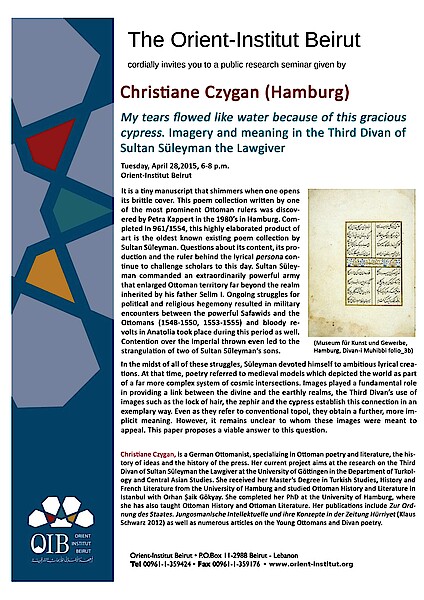
It is a tiny manuscript that shimmers when one opens its brittle cover. This poem collection written by one of the most prominent Ottoman rulers was discovered by Petra Kappert in the 1980’s in Hamburg. Completed in 961/1554, this highly elaborated product of art is the oldest known existing poem collection by Sultan Süleyman. Questions about its content, its production and the ruler behind the lyrical persona continue to challenge scholars to this day.

Sultan Süleyman commanded an extraordinarily powerful army that enlarged Ottoman territory far beyond the realm inherited by his father Selim I. Ongoing struggles for political and religious hegemony resulted in military encounters between the powerful Safawids and the Ottomans (1548-1550, 1553-1555) and bloody revolts in Anatolia took place during this period as well. Contention over the imperial thrown even led to the strangulation of two of Sultan Süleyman’s sons.  

In the midst of all of these struggles, Süleyman devoted himself to ambitious lyrical creations. At that time, poetry referred to medieval models which depicted the world as part of a far more complex system of cosmic intersections. Images played a fundamental role in providing a link between the divine and the earthly realms, the Third Divan’s use of images such as the lock of hair, the zephir and the cypress establish this connection in an exemplary way. Even as they refer to conventional topoi, they obtain a further, more implicit meaning. However, it remains unclear to whom these images were meant to appeal. This paper proposes a viable answer to this question.  


Bio

Dr. Christiane Czygan is a German Ottomanist, specializing in Ottoman poetry and literature, the history of ideas and the history of the press. Her current project aims at the research on the Third Divan of Sultan Süleyman the Lawgiver at the University of Göttingen in the Department of Turkology and Central Asian Studies. She received her Master’s Degree in Turkish Studies, History and French Literature from the University of Hamburg and studied Ottoman History and Literature in Istanbul with Orhan Şaik Gökyay. She completed her PhD at the University of Hamburg, where she has also taught Ottoman History and Ottoman Literature. Her publications include Zur Ordnung des Staates. Jungosmanische Intellektuelle und ihre Konzepte in der Zeitung Hürriyet (Klaus Schwarz 2012) as well as numerous articles on the Young Ottomans and Divan poetry.

Find us on Google Maps

    • footer logo
    • footer log2
    • SITEMAP
    • DATA PROTECTION DISCLAIMER
    • IMPRESSUM
    • Rue Hussein Beyhoum 44
      Zokak el-Blat
    • +9611359423
    • sek@orient-institut.org

Follow us:

© 2021, OIB All Right Reserved.Design & Developed by Comfu