
logo-oibr
  • OIB
    • About
    • News
    • Director's Yearly Address
      • Director's Address 2020
      • Director's Address 2019
      • Director's Address 2018
      • Director's Address 2017
    • Advisory board
    • Reports
    • Newsletter
    • In the Media
    • Gallery
  • Events
  • Research
    • Current projects
      • From Arabic to Latin: Moving sciences of music around the Mediterranean (Rosy Azar Beyhom)
      • Abrahamic Interdependence - Relationship of the Islamic to the Jewish in Marital Law (Ahmed M. F. Abd-Elsalam)
      • Lebanon’s Art World at Home and Abroad: Trajectories of artists and artworks in/from Lebanon since 1943 (LAWHA) (Nadia von Maltzahn)
      • Cultural Policies in Lebanon: Cultural Institutions between State and Society (Nadia von Maltzahn)
      • The New Testament quotations in Ibrahim al-Biqāʿīs (st. 1480) commentary on the Koran (Thomas Würtz)
      • Balance as Justice: Deconstruction of premodern ethics on the basis of Qinālīzāde ꜤḲınālīzāde ʿAlī Çelebī’s Akhlāq-i ꜤAlā’ī (Fatih Ermiş)
      • Fictio Statis (Pierre France)
      • Discourses on Statehood in Iraq (Christian Thuselt)
      • From Copying to Burning the Qur’an: Creating Models & Transposing Sacrality (Alya Karame)
      • Living in Liminality (Sarah El Bulbeisi)
      • Escape to Europe: Comparative Refugee Imaginaries (Markus Schmitz)
    • Previous projects
      • The Lebanese Intifada of October 17: Perspectives from Within (Birgit Schäbler)
      • Relations in the Ideoscape: Middle Eastern Students in the Eastern Bloc (1950's to 1991) (Birgit Schäbler)
      • Europe and the Middle East (Birgit Schäbler)
      • Picturing the (Un)Dead: Reflections and Deconstructions of Lebanese and Iranian "Martyrs" in Contemporary Photo-Related Art-Practices (Agnes Remeder)
      • Hierarchical Rationality of Religious Beliefs System in Islamic and Christian Theology (Qodratullah Qorbani)
      • The inimitability of the Qur’ān (i‘jāz al-qur’ān) in transconfessional contexts of the early ῾Abbāsid period (Hans-Peter Pökel)
      • Cultural Mobilities and Political Spaces (Christopher Bahl)
      • Al-Qadi al-Fadil (Stefan Leder)
      • Bedouin Syria (Johann Büssow)
      • Borrowing and lending (Jonathan Kriener, Ruhr-Universität Bochum)
      • Clergy and conflict management (Thomas Scheffler)
      • Higher Education and Citizenship in Egypt (Daniele Cantini)
      • History Writing at Lebanese Universities (Jonathan Kriener)
      • Knowledge in postgraduate studies (Daniele Cantini)
      • Mamâlik – Spatial Dynamics of Islamic Polities (Kurt Franz)
      • Media culture transformation (Hanan Badr)
      • Museums in Dialogue with the Future (Felicia Meynersen)
      • Political slogans (Nader Srage)
      • Political thought (Stefan Leder)
      • Rural societies in an age of urbanisation (Astrid Meier)
      • S.C.R.I.P.T. - Source Companion for the Research on Islamic Political Thought (Stefan Leder)
      • Talking about art – aesthetic reflection in Egypt and Lebanon (Monique Bellan)
      • Tracing an author’s library (Torsten Wollina)
      • A Literal World: Perceiving the World as a Linguistic Construction before the Emergence of the Metaphor in Arabo-Islamic Thought (Abdallah Soufan)
      • Open Arabic Periodical Editions (OpenArabicPE) (Till Grallert)
      • “Women on the streets!: a genealogy of food riots in the Middle East between the 18th and 20th centuries“ (Till Grallert)
  • People
    • Directorate
    • Research Associates
    • Visiting Fellows
    • Affiliated Researchers
    • Alumni
    • Library
    • Administration
    • IT
    • Publications
    • Technical Staff
    • Vacancies
      • Kinderbetreuung / Leben und Arbeiten im Libanon
  • Publications
    • BI · Bibliotheca Islamica
      • About BI
      • Recent Issues
      • Full List
    • BTS · Beiruter Texte und Studien
      • About BTS
      • Recent Issues
      • Full List
    • OIS · Orient Institut Studies
      • About OIS
      • Recent Issues
      • Full List
    • Extra Series
      • About
      • Recent Issues
      • Full List
    • Latest Publications
  • Library
    • About
      • Library Team
      • History
    • OIB Catalogues
      • GoTriple
      • OPAC
      • IPAC
    • Repositories & databases
    • Online registration
    • Collection
    • Library Regulations
  • Academic Support
    • Fellowships
      • Doctoral Fellowships
      • Postdoctoral Fellowships
      • OIB Research Relief Fellowships 2022/2023
      • Hans-Robert Roemer Fellowships
    • Affiliations
    • Internships
    • Guest rooms
Back to Events

On priests and modes. Or how the author finally got to understand Byzantine chant theory and praxis

Public book presentation

Amine Beyhom

Orient-Institut Beirut

February, 16 to February 17, 2016
16 /02
to
17 /02


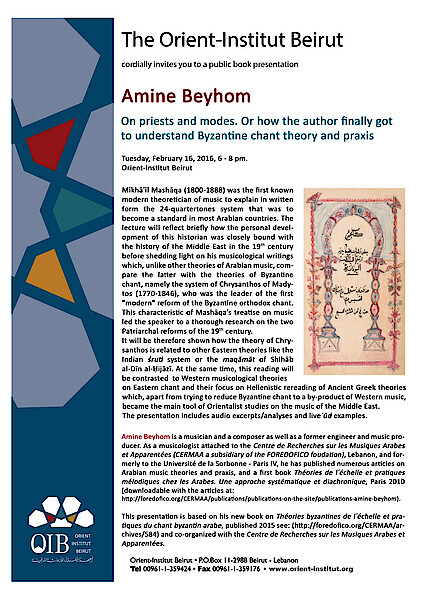
Mīkhāʾīl Mashāqa (1800-1888) was the first known modern theoretician of music to explain in written form the 24-quartertones system that was to become a standard in most Arabian countries. The lecture will reflect briefly how the personal development of this historian was closely bound with the history of the Middle East in the 19th century before shedding light on his musicological writings which, unlike other theories of Arabian music, compare the latter with the theories of Byzantine chant, namely the system of Chrysanthos of Madytos (1770-1846), who was the leader of the first "modern" reform of the Byzantine orthodox chant. This characteristic of Mashāqa’s treatise on music led the speaker to a thorough research on the two Patriarchal reforms of the 19th century.

It will be therefore shown how the theory of Chrysanthos is related to other Eastern theories like the Indian śruti system or the maqāmāt of Shihāb al-Dīn al-Ḥijāzī. At the same time, this reading will be contrasted  to Western musicological theorieson Eastern chant and their focus on Hellenistic rereading of Ancient Greek theories which, apart from trying to reduce Byzantine chant to a by-product of Western music, became the main tool of Orientalist studies on the music of the Middle East. 

The presentation includes audio excerpts/analyses and liveʿūd examples.


Amine Beyhom is a musician and a composer as well as a former engineer and music producer. As a musicologist attached to the Centre de Recherches sur les Musiques Arabes et Apparentées (CERMAA a subsidiary of the FOREDOFICO foudation), Lebanon, and formerly to the Université de la Sorbonne - Paris IV, he has published numerous articles on Arabian music theories and praxis, and a first book Théories de l᾽échelle et pratiques mélodiques chez les Arabes. Une approche systématique et diachronique, Paris 2010 (downloadable with the articles at:

foredofico.org/CERMAA/publications/publications-on-the-site/publications-amine-beyhom 


This presentation is based on his new book on Théories byzantines de l᾽échelle et pratiques du chant byzantin arabe, published 2015 see: (http://foredofico.org/CERMAA/archives/584) and co-organized with the Centre de Recherches sur les Musiques Arabes et Apparentées.

Find us on Google Maps

    • footer logo
    • footer log2
    • SITEMAP
    • DATA PROTECTION DISCLAIMER
    • IMPRESSUM
    • Rue Hussein Beyhoum 44
      Zokak el-Blat
    • +9611359423
    • sek@orient-institut.org

Follow us:

© 2021, OIB All Right Reserved.Design & Developed by Comfu