logo-oibr
  • OIB
    • About
    • News
    • Director's Yearly Address
      • Director's Address 2020
      • Director's Address 2019
      • Director's Address 2018
      • Director's Address 2017
    • Advisory board
    • Reports
    • Newsletter
    • In the Media
    • Gallery
  • Events
  • Research
    • Current projects
      • From Arabic to Latin: Moving sciences of music around the Mediterranean (Rosy Azar Beyhom)
      • Abrahamic Interdependence - Relationship of the Islamic to the Jewish in Marital Law (Ahmed M. F. Abd-Elsalam)
      • Lebanon’s Art World at Home and Abroad: Trajectories of artists and artworks in/from Lebanon since 1943 (LAWHA) (Nadia von Maltzahn)
      • Cultural Policies in Lebanon: Cultural Institutions between State and Society (Nadia von Maltzahn)
      • The New Testament quotations in Ibrahim al-Biqāʿīs (st. 1480) commentary on the Koran (Thomas Würtz)
      • Balance as Justice: Deconstruction of premodern ethics on the basis of Qinālīzāde ꜤḲınālīzāde ʿAlī Çelebī’s Akhlāq-i ꜤAlā’ī (Fatih Ermiş)
      • Fictio Statis (Pierre France)
      • Discourses on Statehood in Iraq (Christian Thuselt)
      • From Copying to Burning the Qur’an: Creating Models & Transposing Sacrality (Alya Karame)
      • Living in Liminality (Sarah El Bulbeisi)
      • Escape to Europe: Comparative Refugee Imaginaries (Markus Schmitz)
    • Previous projects
      • The Lebanese Intifada of October 17: Perspectives from Within (Birgit Schäbler)
      • Relations in the Ideoscape: Middle Eastern Students in the Eastern Bloc (1950's to 1991) (Birgit Schäbler)
      • Europe and the Middle East (Birgit Schäbler)
      • Picturing the (Un)Dead: Reflections and Deconstructions of Lebanese and Iranian "Martyrs" in Contemporary Photo-Related Art-Practices (Agnes Remeder)
      • Hierarchical Rationality of Religious Beliefs System in Islamic and Christian Theology (Qodratullah Qorbani)
      • The inimitability of the Qur’ān (i‘jāz al-qur’ān) in transconfessional contexts of the early ῾Abbāsid period (Hans-Peter Pökel)
      • Cultural Mobilities and Political Spaces (Christopher Bahl)
      • Al-Qadi al-Fadil (Stefan Leder)
      • Bedouin Syria (Johann Büssow)
      • Borrowing and lending (Jonathan Kriener, Ruhr-Universität Bochum)
      • Clergy and conflict management (Thomas Scheffler)
      • Higher Education and Citizenship in Egypt (Daniele Cantini)
      • History Writing at Lebanese Universities (Jonathan Kriener)
      • Knowledge in postgraduate studies (Daniele Cantini)
      • Mamâlik – Spatial Dynamics of Islamic Polities (Kurt Franz)
      • Media culture transformation (Hanan Badr)
      • Museums in Dialogue with the Future (Felicia Meynersen)
      • Political slogans (Nader Srage)
      • Political thought (Stefan Leder)
      • Rural societies in an age of urbanisation (Astrid Meier)
      • S.C.R.I.P.T. - Source Companion for the Research on Islamic Political Thought (Stefan Leder)
      • Talking about art – aesthetic reflection in Egypt and Lebanon (Monique Bellan)
      • Tracing an author’s library (Torsten Wollina)
      • A Literal World: Perceiving the World as a Linguistic Construction before the Emergence of the Metaphor in Arabo-Islamic Thought (Abdallah Soufan)
      • Open Arabic Periodical Editions (OpenArabicPE) (Till Grallert)
      • “Women on the streets!: a genealogy of food riots in the Middle East between the 18th and 20th centuries“ (Till Grallert)
  • People
    • Directorate
    • Research Associates
    • Visiting Fellows
    • Affiliated Researchers
    • Alumni
    • Library
    • Administration
    • IT
    • Publications
    • Technical Staff
    • Vacancies
      • Kinderbetreuung / Leben und Arbeiten im Libanon
  • Publications
    • BI · Bibliotheca Islamica
      • About BI
      • Recent Issues
      • Full List
    • BTS · Beiruter Texte und Studien
      • About BTS
      • Recent Issues
      • Full List
    • OIS · Orient Institut Studies
      • About OIS
      • Recent Issues
      • Full List
    • Extra Series
      • About
      • Recent Issues
      • Full List
    • Latest Publications
  • Library
    • About
      • Library Team
      • History
    • OIB Catalogues
      • GoTriple
      • OPAC
      • IPAC
    • Repositories & databases
    • Online registration
    • Collection
    • Library Regulations
  • Academic Support
    • Fellowships
      • Doctoral Fellowships
      • Postdoctoral Fellowships
      • OIB Research Relief Fellowships 2022/2023
      • Hans-Robert Roemer Fellowships
    • Affiliations
    • Internships
    • Guest rooms
Back to Events

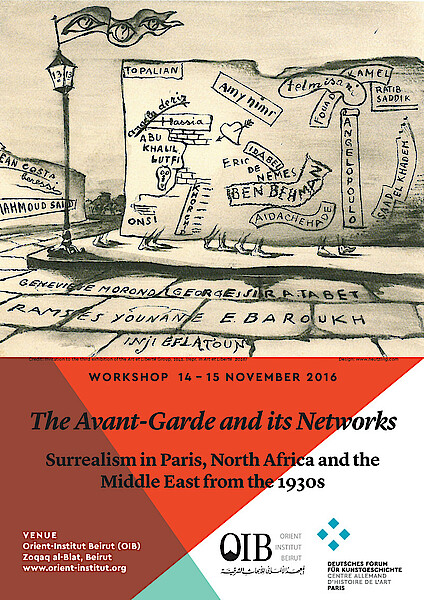
The Avant-garde and its Networks: Surrealism in Paris, North Africa and the Middle East from the 1930s

International Workshop

Orient-Institut Beirut

November, 14 to November 15, 2016
14 /11
to
15 /11


Program PDF


Organizers: Orient-Institut Beirut/Deutsches Forum für Kunstgeschichte Paris


Surrealism - along with Futurism - can be considered as one of the few avant-garde movements of the early twentieth century that was established in Cairo. In 1939, Georges Henein, Kamel el-Telmessany, Ramses Younan and Anwar and Fouad Kamel founded the Art and Freedom group (Jamaat al fann wal-hurriya), which continued until the late 1940s. The group was probably the only official one in the region with a direct link to André Breton. Surrealist ideas also spread to other places in the region: In Beirut in the early 1930s for example, a group of writers, artists and intellectuals, including Georges Schéhadé, Georges Cyr, Antoine Tabet, Gabriel Bounoure and others, met regularly and debated Surrealism. This group never became official, though, or released a manifesto. A few decades later, in 1981, the Algerian writer Habib Tengour authored a “Manifesto of Maghrebian Surrealism”, in which he relates Surrealism to Sufism.


The Paris of André Breton is commonly recognized as the intellectual and artistic center from which Surrealism spread into other European and non-European cities. This was mainly due to individuals who lived and worked in Paris for a certain period of time, mingled in Surrealist circles and took back the new ideas to their home countries. Others, such as the Iraqi writer Abdel Kader el-Janabi, who settled in Paris in the 1970s, embraced Surrealist ideas outside their country or culture of reference, but never tried to transfer them.


Research into Surrealism in the Middle East and North Africa is still in its infancy, despite an increased interest in the subject in the last couple of years, especially in Egypt’s Art and Freedom group. The Orient-Institut Beirut and the German Forum for Art History in Paris are therefore convening a workshop that will focus on the international networks between Paris, Beirut, Cairo, and other cities from North Africa to Iran. The workshop seeks to shed light on Surrealism as a political, social, literary and artistic phenomenon that migrated beyond Europe, but remained closely tied to its Parisian heartland, at least at the beginning. It is generally assumed that the artistic and cultural exchanges took place mainly between the “center” in Paris and the respective “peripheries”, and less so between the peripheries themselves. This needs to be examined in more depth, and the power relationship between center and periphery itself needs to be questioned and discussed. The workshop is directed at both established and early career scholars from various fields, to come together in order to stimulate and take forward the debate on Surrealism in North Africa and the Middle East.


The aim is to gather information about the networks and the reception of Surrealism and thereby to approach its dissemination in the region more systematically. In addition to this structural dimension, the workshop will attempt to look at the qualitative aspects of the movement’s literary and artistic production and possible lineages. How was Surrealism transported to different places, and who were the actors? To what extent was Surrealism in the region associated with the presence and activity of Europeans living abroad? Can we identify connections between artists, galleries, magazines and newspapers, collectors, patrons, and places of encounter on a transregional as well as a transnational level? How were Surrealist ideas adapted to local contexts and how was the movement developed or reshaped by following generations?

Find us on Google Maps

    • footer logo
    • footer log2
    • SITEMAP
    • DATA PROTECTION DISCLAIMER
    • IMPRESSUM
    • Rue Hussein Beyhoum 44
      Zokak el-Blat
    • +9611359423
    • sek@orient-institut.org

Follow us:

© 2021, OIB All Right Reserved.Design & Developed by Comfu