Orient-Institut Beirut
October, 31 to November 02, 2017
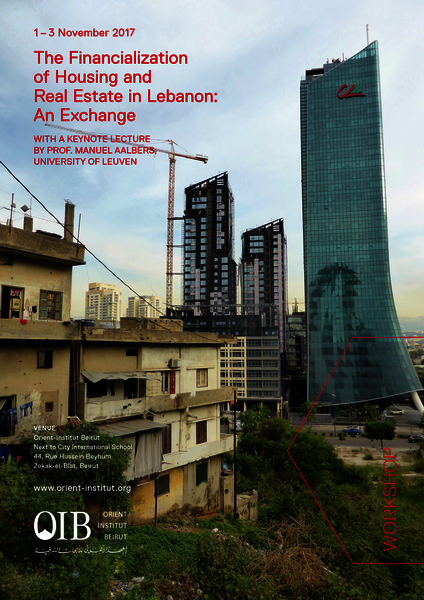
This workshop explores the relationships between processes of financialization and the housing and real estate sectors in Lebanon. It brings foreign and Lebanese academics and experts together in order to explore common themes and foster mutual learning through their knowledge of different contexts. The workshop will contribute to the formation of a research agenda that explores new forms of finance-based housing and financialized real estate development in a severely understudied region and provide clues about whether they create the same kind of volatilities that led to the global financial crisis, and which new kinds of urban economies, trajectories of urbanization, spatial inequalities, and geographies of financial markets and products they generate.
What do we mean by the term “financialization”? Financialization entails the “increasing dominance of financial actors, markets, practices, measurements and narratives, at various scales, resulting in a structural transformation of economies, firms (including financial institutions), states and households” (Aalbers, 2017). This process can be situated in the shift towards finance- based growth that has been occurring ever since the slowing down of economic growth and stagnation of the real economy in the West (Aalbers, 2008). In finance-based growth, profit is made through financial channels, instead of through trade and commodity production (Epstein, 2005; Krippner, 2005). Finance grows not to benefit the economy, but to benefit financial market agents, including investors. Financial and non-financial firms alike are increasingly intertwined with financial markets, which become a place where money, securities and other purely financial products are traded. In this way, the risks of financial markets are spread all around the economy, as financial and non-financial economic activities are becoming financialized (Aalbers, 2008).
The workshop focuses on two interrelated domains that are susceptible to processes of financialization, namely housing and real estate. In Lebanon, the growing housing loans market, the availability of large amounts of excess liquidity in the banks and the traditional dominance of the banking and real estate sectors create an environment conducive to financialization. At the same time, conservative banking policies and limited financial markets seem to check this trend. Different panels, keynotes and roundtables will explore these issues, starting on the evening of November 1 with a keynote address by Prof. Manuel Aalbers (Leuven University, Belgium).
17:00-18:00 | Opening keynote The Real Estate/Financial Complex. Dr. Manuel Aalbers (Associate Professor of Geography, University of Leuven). |
18:00-19:30 | Welcome reception |
9:00-9:30 | Welcome and coffee |
9:30-10:00 | Opening |
10:00-10:30 | Disentangling the Gordian knot: How the European banking system grew to the eve of the 2008 Eurocrisis. Dr. Michiel van Meeteren (Postdoctoral Fellow in Geography, Free University Brussels). |
10:30-11:00 | Land as a financial asset versus as an input for economy: Processes, adaptation and adjustment. Dr. Charbel Nahas (Consultant and Lecturer in Economy, American University of Beirut). |
11:00-11:30 | The Lebanese economy in the aftermath of the 2008 financial crisis: Causes and consequences of the boom. Mr. Marwan Mikhael (Head of Research, BLOMInvest Bank). |
11:30-12:00 | The crisis that was a boom: Emerging mortgage markets in Lebanon.
|
12:00-13:30 | Lunch break |
13:30-14:00 | The housing market in Lebanon. Dr. Ali Termos (Assistant Professor of Economics, American University of Beirut). |
14:00-14:30 | Access to housing for low to middle-incomes: The role of the Public Corporation for Housing. Eng. Rony Lahoud (Chairman and General Director, Public Corporation for Housing). |
14:30-15:00 | Initiatives of the Central Bank in financing housing loans. Mr. Najib Choucair (Head of Banking Department, Central Bank of Lebanon).
|
15:30-16:00 | Coffee break |
16:00-16:30 | Gatekeeping the Islamic frontier: A relational urban political economy of Islamic finance. Dr. David Bassens (Assistant Professor of Economic Geography, Free University Brussels). |
16:30-17:00 | Financialization beyond the rent gap. Dr. William Kutz (Lecturer in Geography, Manchester University). |
17:00-17:30 | The financialization of food and farmland in Africa. Dr. Giuliano Martiniello (Assistant Professor of Rural Community Development, American University of Beirut). Discussant: Dr. Manuel Aalbers (Associate Professor of Geography, University of Leuven). |
09:30-10:00 | Rent controlled housing stock: An opportunity for diverse housing programs. Ms. Abir Saksouk (architect/researcher, Public Works Studio) and Ms. Nadine Bekdache (graphic designer/researcher, Public Works Studio). |
10:00-10:30 | Affordable housing in Beirut: Policy and institutional options. Ms. Elisabetta Pietrostefani (Social Justice and the City-program, American University of Beirut; PhD-candidate, London School of Economics).
|
10:30-11:00 | Affordability of public private mortgage schemes in Lebanon in 2004-2010: A paradox revealed. Dr. Abdallah Nassereddine (Associate Professor of Economics, Beirut Arab University). |
11:00-11:15 | Coffee break
|
11:15-11:45 | The institutionalization of real estate developers in Lebanon: Implications for activities in Europe. Ms. Mireille Korab Abi Nasr (Head of Business Development, FFA Real Estate, Vice President, Real Estate Developers’ Association Lebanon (REDAL).
|
11:45-12:15 | Real estate valuation and its impact on financialization: Case studies from Germany, Spain and Mexico. Ms. Eugenia Winter (PhD-candidate in Geography, Goethe University Frankfurt). |
12:15-12:45 | The role of Capital Markets Authority in regulating, monitoring and developing the financial markets. Ms. Caline Aoun Maraaoui (Head of Legal Affairs, Capital Markets Authority Lebanon). Discussant: Dr. Ramzi Mabsout (Assistant Professor of Economics, American University of Beirut). |
13:15-14:00 | Lunch break |
14:00-14:30 | Financialization, Central Banking and the housing market. Dr. Ghassan Dibeh (Professor of Economics, Lebanese American University). |
14:30-15:00 | Why real estate in Lebanon will keep on crashing. Mr. Jihad El Hokayem (Chief Financial Market Strategist, EMBA Lecturer in real estate investment strategy, Lebanese American University). |
15:00-15:30 | Ranking Lebanese banks using the principal component analysis and the logit model. Dr. Viviane Naïmy (Professor of Finance, Chairperson, Accounting and Finance Department, Notre Dame University). |
15:30-16:00 | Invisible claws: How the real estate bubble is strangling the Lebanese economy. Mr. Dan Azzi (Former CEO and Chairman of Standard Chartered Bank). Discussant: Dr. Walid Marrouch (Associate Professor of Economics, Lebanese American University). |
16:15-16:30 | Coffee break
|
16:30-17:30 | CLOSING ROUNDTABLE: The future of Lebanon’s housing, real estate and finance sectors. Dr. Jad Chaaban (Associate Professor of Economics, American University of Beirut). Dr. Mounir Rached (Advisor, Ministry of Finance; President, Lebanese Economic Association; Lecturer, American University of Beirut).
|
For more information, please contact Marieke Krijnen at krijnen@orient-institut.org